Who owns the rain
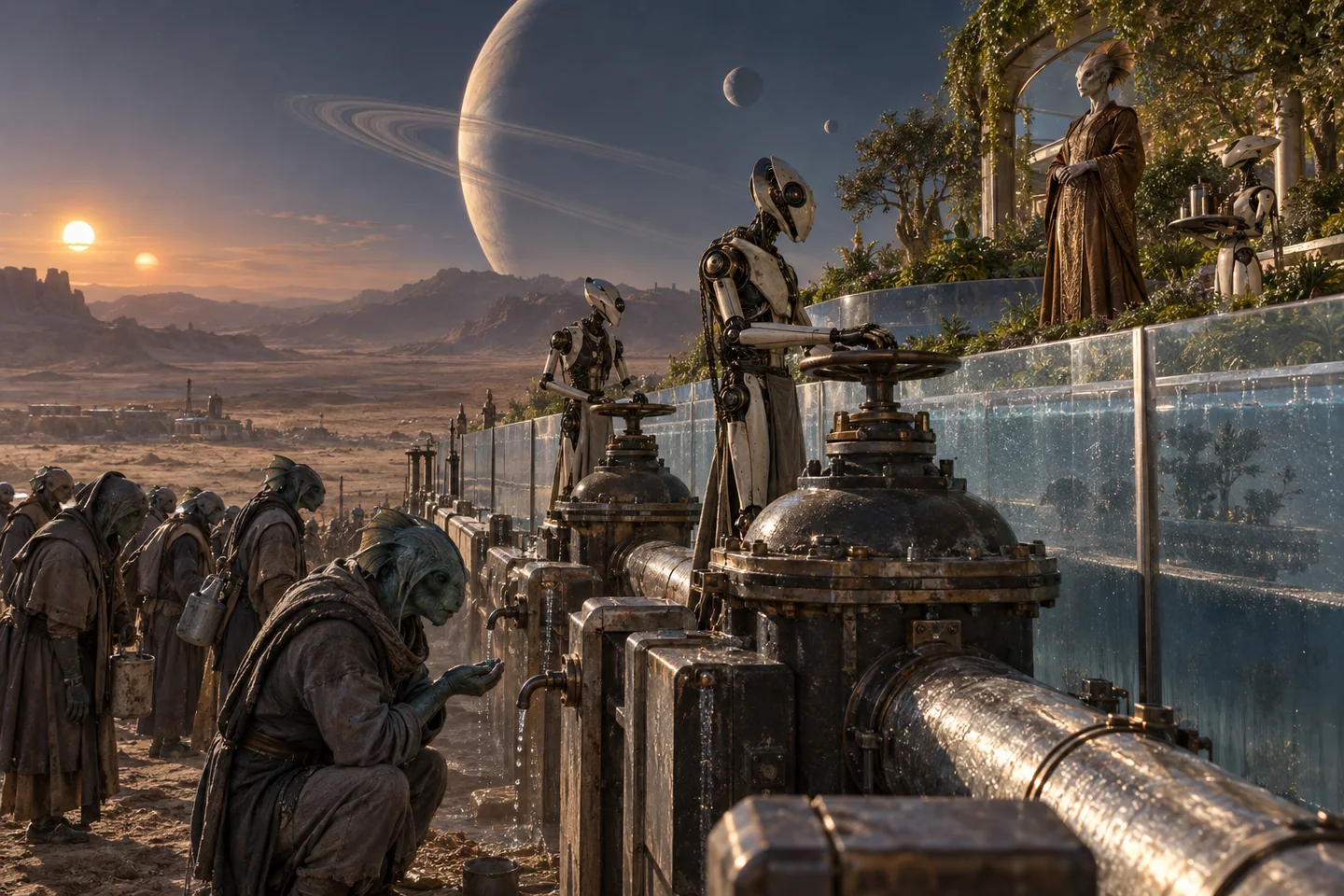
Precise irrigation sustains a private garden while residents beyond its boundary collect scarce water. Utility machines maintain the distribution system. A ringed planet and two stars dominate the dusty sky. The imagined tragedy lies in the rules governing access to resources, not in a technical failure of the machines.
The imagined scene
The host system is real. All alien organisms, robots, societies and social histories are fictional. Moons, rings, terrain and weather are artistic assumptions unless specifically supported by a cited source. These images are not calibrated simulations of the sky.
The scientific anchor
Kepler-35 b is a catalogued planet orbiting two stars, with orbital period 131.458 days and radius 8.16 Earth radii. The real planet is gas-rich. The depicted solid ground is on a hypothetical satellite, not a known planetary surface. The moons, rings, living species, robots and social history are fictional. These scenes are possibilities in a story, not observations or inevitable predictions about AI.
Available measurements
Host: Kepler-35 · 2 catalog star(s) · Giant-size planet
NASA composite catalog values may combine different papers. Errors and upper/lower limits are retained. “Calculated Value” means derived or estimated. Msini is a minimum mass. Missing values are unknown. A multiple-star system’s single stellar row does not describe every component. Equilibrium temperature is not a measured surface temperature.
| Quantity | Value & uncertainty | Unit | Paper / source |
|---|---|---|---|
| Planet radius | 8.16 [+0.157 / -0.157] | Earth radii | Welsh et al. 2012 |
| Planet mass | 40.363 [+6.356 / -6.356] | Earth masses | Welsh et al. 2012 |
| Bulk density | 0.41 [+0.07 / -0.069] | g/cm³ | Welsh et al. 2012 |
| Orbital period | 131.46 [+0.077 / -0.105] | days | Welsh et al. 2012 |
| Orbital semimajor axis | 0.60347 [+0.00101 / -0.00103] | AU | Welsh et al. 2012 |
| Orbital eccentricity | 0.042 [+0.007 / -0.004] | Welsh et al. 2012 | |
| Orbital inclination | 90.76 [+0.12 / -0.09] | degrees | Welsh et al. 2012 |
| Irradiation | 2.5804 [+0.2764 / -0.2764] | Earth flux | Calculated Value |
| Equilibrium temperature | 352.89 [+9.45 / -9.45] | K; not surface temperature | Calculated Value |
| Catalog stellar effective temperature | 5,606 [+150 / -150] | K | Welsh et al. 2012 |
| Catalog stellar radius | 1.0284 [+0.002 / -0.0019] | Solar radii | Welsh et al. 2012 |
| Catalog stellar mass | 0.8877 [+0.0051 / -0.0053] | Solar masses | Welsh et al. 2012 |
| Catalog stellar luminosity | -0.027 [+0.044 / -0.049] | log10 Solar luminosity | Welsh et al. 2012 |
| Catalog stellar age | Unknown | Gyr | Source not supplied |
| Catalog stellar metallicity | -0.34 [+0.2 / -0.2] | dex | Welsh et al. 2012 |
| System distance | 1,819.2 [+120.96 / -107.03] | pc | TICv8 |
What about life?
Likely a deep gaseous envelope, without a solid exterior surface. Atmospheric or moon life is speculative; this is not proof that all life is impossible. No confirmed life; no planet-specific biosignature literature review in this release.