The ice vigil
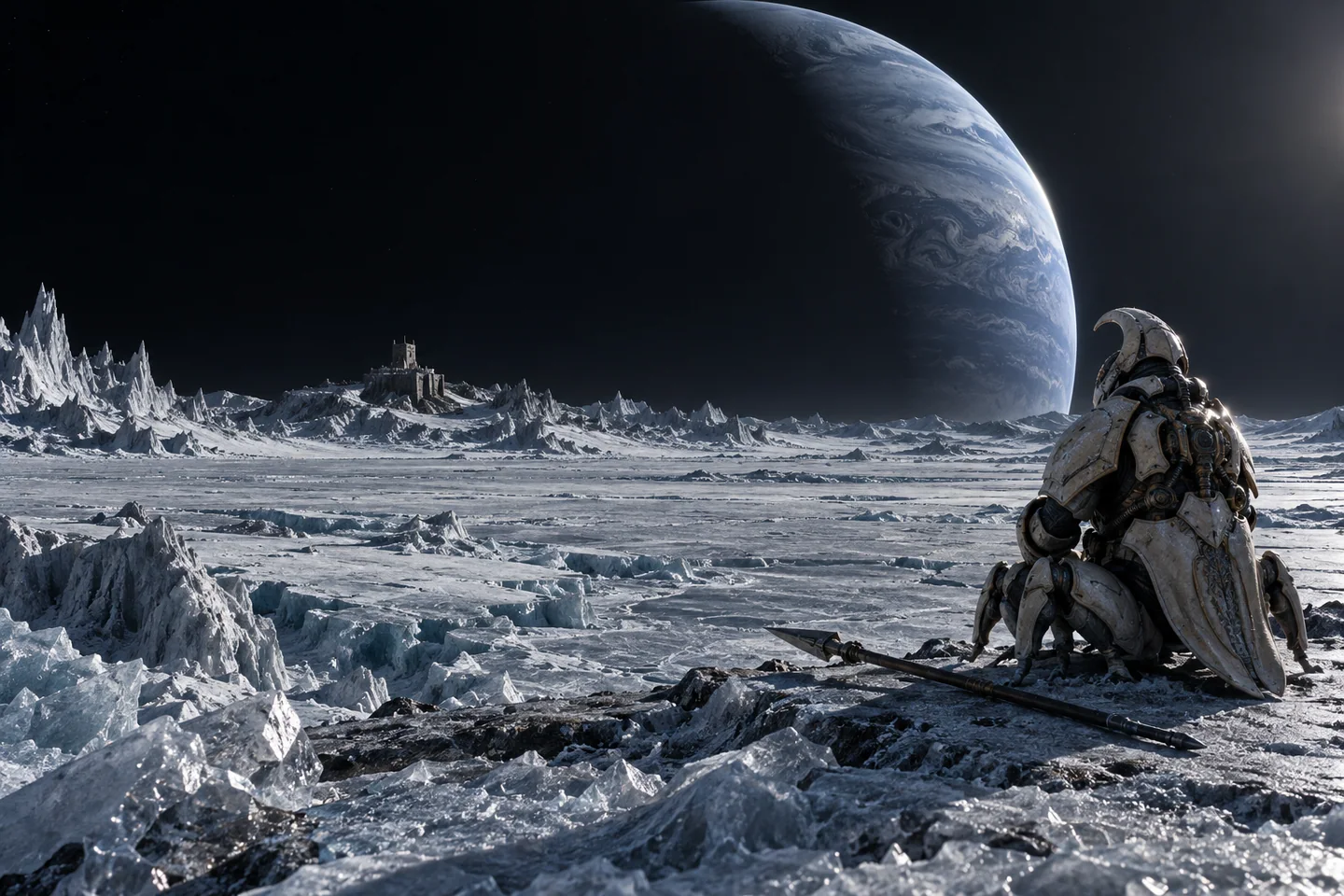
A sealed armored warrior keeps silent vigil on an invented airless ice moon. The crescent parent planet dominates the sky; suit and refuge are fictional life-support technology. Fictional warrior portrait: Inside his sealed armor, breath and heartbeat keep their small, private rhythm. Outside lies an ice field without air. He has come to sit where every careless movement would matter, carrying shelter, preparation and the knowledge of when to return. Endurance begins long before the vigil, in the discipline that makes it possible. Before leaving the refuge, he checked each seal and connection with another member of the watch. The ritual was practical, with no gesture wasted on ceremony. They looked where the other might overlook, repeated the figures, and agreed on the point at which he would turn back. Alone on the ice, he carries the benefit of that shared attention inside every working system of the suit. The stillness outside can suggest an absence of change, but his vigil depends on change being measured. Reserves diminish. His body produces heat. Materials respond to the environment. He attends to these ordinary facts without allowing them to crowd out the view. Courage here includes the ability to remain curious while staying answerable to the instruments that make curiosity survivable. He has no wish to prove that he can endure indefinitely. Such a claim would make his companions responsible for rescuing his pride. The harder discipline is to honor a limit while there is still strength to cross back safely. He thinks of the distant refuge as a promise made by a community: someone expects him to return, and his return matters more than the duration of the vigil. Above the ice, the illuminated edge of the parent world holds his gaze. It makes shelter seem both fragile and extraordinary. A little warmth, a controlled atmosphere, a patient exchange of signals—these are enough to give a living creature time to contemplate the immensity around it. He will carry that knowledge home as gratitude, rather than as a tale of having conquered the cold. The crescent world gives him a measure of his own scale. He is vulnerable here, and knowing that is part of his strength. His bond with the cosmos is physical: heat conserved, energy spent wisely, a living body sustained for one more moment within an immense indifferent night.
The imagined scene
The host system is real. All alien organisms, robots, societies and social histories are fictional. Moons, rings, terrain and weather are artistic assumptions unless specifically supported by a cited source. These images are not calibrated simulations of the sky.
The scientific anchor
HD 45364 b is a real catalogued exoplanet orbiting HD 45364. The local NASA composite snapshot lists an orbital period of 225.79 days; the companion measurement table preserves reported uncertainties, limits and source provenance. The viewpoint is: imagined airless ice moon. All warriors, cultures, training practices and constructed environments are fictional. The depicted ground belongs to an invented moon, not to an exposed solid surface of the giant planet. No exomoon detection is claimed.
Li et al. 2022 · NASA Exoplanet Archive system overview · Correia et al. 2009 · TICv8
Available measurements
Host: HD 45364 · 1 catalog star(s) · Giant-size planet
NASA composite catalog values may combine different papers. Errors and upper/lower limits are retained. “Calculated Value” means derived or estimated. Msini is a minimum mass. Missing values are unknown. A multiple-star system’s single stellar row does not describe every component. Equilibrium temperature is not a measured surface temperature.
| Quantity | Value & uncertainty | Unit | Paper / source |
|---|---|---|---|
| Planet radius | 9.03 | Earth radii | Calculated Value |
| Planet mass | 60.165 [+1.9705 / -2.0023] | Earth masses | Li et al. 2022 |
| Bulk density | 0.449 | g/cm³ | Calculated Value |
| Orbital period | 225.79 [+0.81 / -0.76] | days | Li et al. 2022 |
| Orbital semimajor axis | 0.6793 [+0.0016 / -0.0015] | AU | Li et al. 2022 |
| Orbital eccentricity | 0.067 [+0.016 / -0.016] | Li et al. 2022 | |
| Orbital inclination | Unknown | degrees | Source not supplied |
| Irradiation | 1.3804 [+0.0076 / -0.0076] | Earth flux | Calculated Value |
| Equilibrium temperature | 301.69 [+3.59 / -3.59] | K; not surface temperature | Calculated Value |
| Catalog stellar effective temperature | 5,466 [+59 / -32] | K | Li et al. 2022 |
| Catalog stellar radius | 0.89 [+0.01 / -0.02] | Solar radii | Li et al. 2022 |
| Catalog stellar mass | 0.82 [+0.05 / -0.05] | Solar masses | Li et al. 2022 |
| Catalog stellar luminosity | -0.19586 [+0.00136 / -0.00137] | log10 Solar luminosity | Li et al. 2022 |
| Catalog stellar age | Unknown | Gyr | Source not supplied |
| Catalog stellar metallicity | -0.17 [+0.01 / -0.01] | dex | Correia et al. 2009 |
| System distance | 34.354 [+0.0376 / -0.0375] | pc | TICv8 |
What about life?
Likely a deep gaseous envelope, without a solid exterior surface. Atmospheric or moon life is speculative; this is not proof that all life is impossible. Radius is estimated from a minimum mass, so even the size/composition inference is especially uncertain. No confirmed life; no planet-specific biosignature literature review in this release.
Papers and references
Li et al. 2022 · NASA Exoplanet Archive system overview · Correia et al. 2009 · TICv8