The red horizon
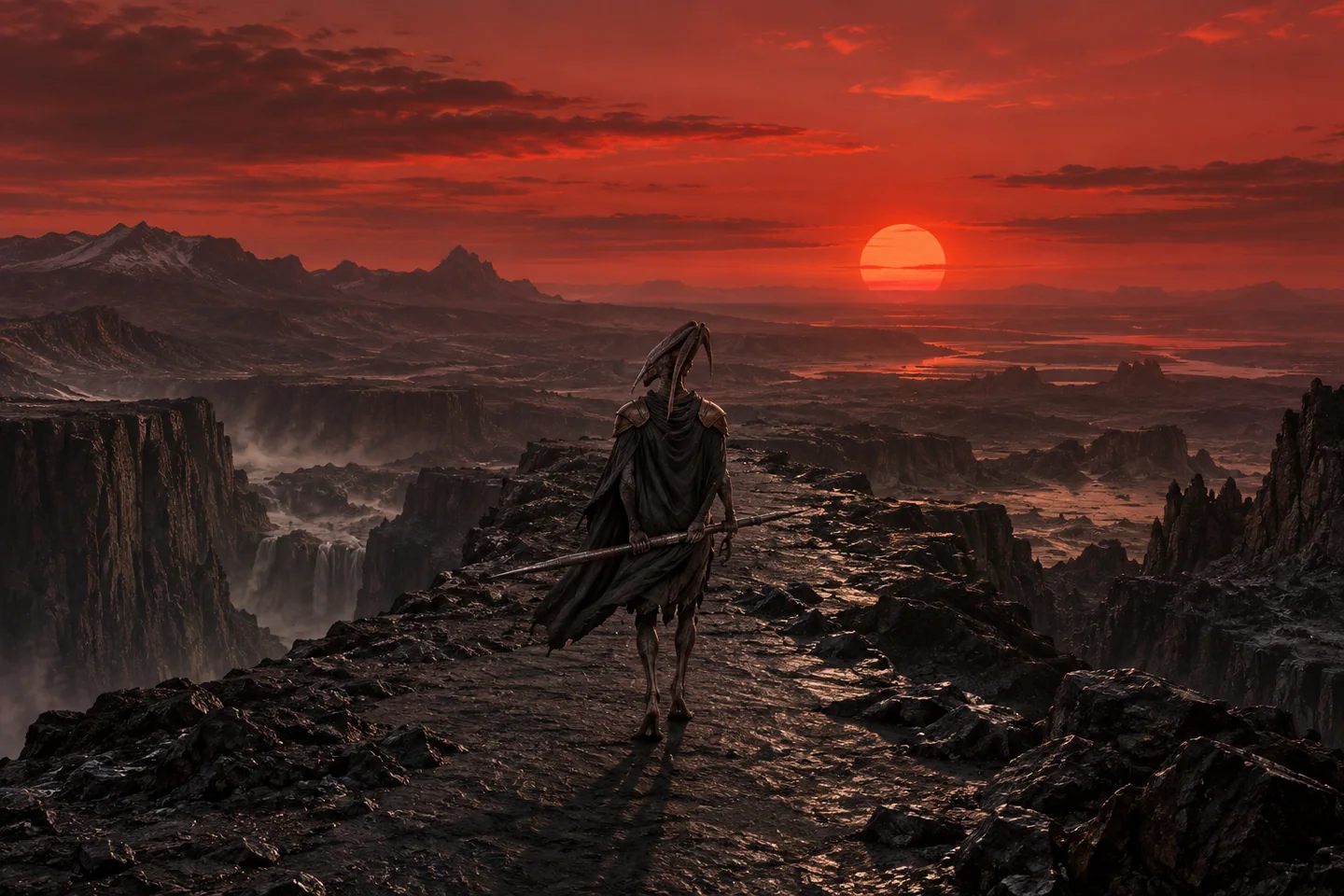
A warrior carries a staff along a canyon causeway beneath a red stellar horizon. The terrain, water-like reflections, mist, atmosphere and civilization are invented. Fictional warrior portrait: He follows the causeway toward the red horizon, the staff resting behind him. There is no adversary at its end. The walk is a daily promise to keep moving with care when the destination offers no certainty. Each step asks for strength; each pause asks for honesty about what strength remains. From a distance, the causeway looks continuous. Underfoot it is a succession of uneven surfaces, each requiring a slightly different placement. He has learned to look far enough ahead to choose a direction and close enough to make the next step sound. On difficult days his attention collapses toward one extreme: the distant end becomes overwhelming, or the immediate effort makes him forget why he began. The staff across his back opens his shoulders and gives the walk a deliberate rhythm. There is no count he must reach to make the day worthwhile. Some days he travels less and notices more. Others ask for sustained effort. His resolve survives those differences because it rests on returning to the practice, rather than demanding that every return resemble the one before it. He sometimes imagines how the scene might appear to an observer far from this star: no solitary walker, no narrow bridge, perhaps only an unresolved point. The thought briefly erases the importance he has assigned to being seen. His actions still have consequences at the scale where he lives. The next person to use the path will encounter whatever he has repaired, neglected or left behind. At the turning place he will rest and inspect the route home. Persistence includes that change of direction. He can remain faithful to a purpose while revising the way he pursues it. Under the red horizon, the walk becomes an agreement between aspiration and circumstance, renewed one step at a time by a creature who cannot know the whole road. Beneath the small star, resolve becomes something quieter than conquest. He belongs to a world whose weather and stone set their own conditions. His connection to the cosmos is the acceptance of those conditions, joined to the freedom to choose his next deliberate step.
The imagined scene
The host system is real. All alien organisms, robots, societies and social histories are fictional. Moons, rings, terrain and weather are artistic assumptions unless specifically supported by a cited source. These images are not calibrated simulations of the sky.
The scientific anchor
Proxima Cen b is a real catalogued exoplanet orbiting Proxima Cen. The local NASA composite snapshot lists an orbital period of 11.18465 days; the companion measurement table preserves reported uncertainties, limits and source provenance. The viewpoint is: speculative planetary surface. All warriors, cultures, training practices and constructed environments are fictional.
Suárez Mascareño et al. 2025 · NASA Exoplanet Archive system overview · Anglada-Escudé et al. 2016 · TICv8
Available measurements
Host: Proxima Cen · 3 catalog star(s) · Rocky-size candidate
NASA composite catalog values may combine different papers. Errors and upper/lower limits are retained. “Calculated Value” means derived or estimated. Msini is a minimum mass. Missing values are unknown. A multiple-star system’s single stellar row does not describe every component. Equilibrium temperature is not a measured surface temperature.
| Quantity | Value & uncertainty | Unit | Paper / source |
|---|---|---|---|
| Planet radius | 1.02 | Earth radii | Calculated Value |
| Planet mass | 1.055 [+0.055 / -0.055] | Earth masses | Suárez Mascareño et al. 2025 |
| Bulk density | 5.46 | g/cm³ | Calculated Value |
| Orbital period | 11.185 [+0.00053 / -0.00053] | days | Suárez Mascareño et al. 2025 |
| Orbital semimajor axis | 0.04848 [+0.00029 / -0.00029] | AU | Suárez Mascareño et al. 2025 |
| Orbital eccentricity | 0 | Suárez Mascareño et al. 2025 | |
| Orbital inclination | Unknown | degrees | Source not supplied |
| Irradiation | 0.641 [+0.065 / -0.065] | Earth flux | Suárez Mascareño et al. 2025 |
| Equilibrium temperature | 218 [+18 / -18] | K; not surface temperature | Suárez Mascareño et al. 2025 |
| Catalog stellar effective temperature | 2,900 [+100 / -100] | K | Suárez Mascareño et al. 2025 |
| Catalog stellar radius | 0.141 [+0.021 / -0.021] | Solar radii | Suárez Mascareño et al. 2025 |
| Catalog stellar mass | 0.1221 [+0.0022 / -0.0022] | Solar masses | Suárez Mascareño et al. 2025 |
| Catalog stellar luminosity | -2.821 [+0.02242 / -0.02364] | log10 Solar luminosity | Suárez Mascareño et al. 2025 |
| Catalog stellar age | Unknown | Gyr | Source not supplied |
| Catalog stellar metallicity | Unknown | dex | Source not supplied |
| System distance | 1.3012 [+0.00034 / -0.00035] | pc | TICv8 |
What about life?
Passes a deliberately broad 0.25–1.75 Earth-flux triage window. This is not a calculated habitable zone or evidence of water or life. Atmosphere, surface pressure, water inventory, stellar activity and orbital history remain unassessed. Radius is estimated from a minimum mass, so even the size/composition inference is especially uncertain. No confirmed life; no planet-specific biosignature literature review in this release.
Papers and references
Suárez Mascareño et al. 2025 · NASA Exoplanet Archive system overview · Anglada-Escudé et al. 2016 · TICv8