The night practice
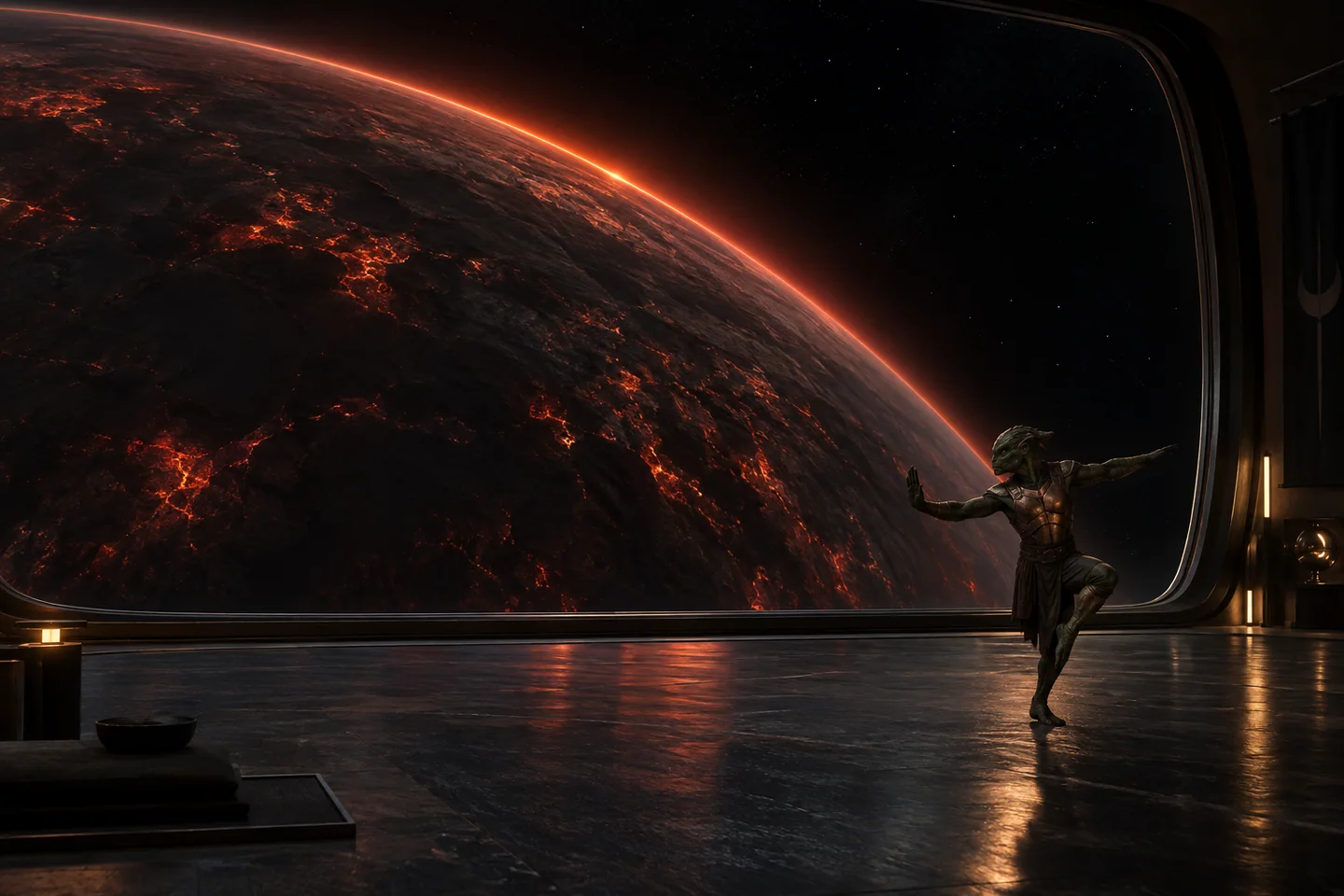
An alien warrior holds a one-foot balance inside a pressure habitat. The night hemisphere and glowing fissures are an imagined thermal landscape, not a resolved map of this planet. Fictional warrior portrait: She raises one foot and opens her hands. Beyond the pressure window, the planet’s imagined heat traces a red boundary through the darkness. Inside, her task is small and exact: to remain balanced without stiffening, and to recover without anger when balance is lost. For several breaths, the balance seems effortless. Then a slight shift travels upward from the supporting foot. She reaches too far in correcting it and sets the raised foot down. The mistake is ordinary, yet irritation arrives immediately. She feels the temptation to repeat the pose at once, as though a successful attempt could erase the failed one. Instead she waits until she can begin without arguing with what already happened. This pause is the central exercise. Her mind prefers a story in which discipline has made her permanently steady. Her body offers more useful information: attention fluctuates, fatigue accumulates, and familiar movements still require care. She lets the story loosen. A practice that allows her to notice these changes can serve her longer than an image of herself that must be defended from them. The bright curve outside the chamber adds intensity without demanding a response. She can look toward it and still feel the floor beneath her. Awe and composure need not cancel one another. The sight reminds her that a strong feeling can occupy the mind without taking command of every movement, and that wonder can remain open even when concentration is precise. On the next attempt she balances for a shorter time, but lowers the foot deliberately. That ending matters. She has chosen it while still attentive, rather than waiting for strain to choose for her. When she leaves the chamber, she hopes to carry the same freedom into moments of urgency: enough steadiness to recognize a limit, enough patience to recover, and enough courage to try again. The contrast does not make her powerful enough to command a world. It reminds her where her responsibility begins. A warrior’s composure is something she can practice in her own body. Against a cosmic scale, that narrow sphere of responsibility becomes clearer, and more precious.
The imagined scene
The host system is real. All alien organisms, robots, societies and social histories are fictional. Moons, rings, terrain and weather are artistic assumptions unless specifically supported by a cited source. These images are not calibrated simulations of the sky.
The scientific anchor
55 Cnc e is a real catalogued exoplanet orbiting 55 Cnc. The local NASA composite snapshot lists an orbital period of 0.7365474 days; the companion measurement table preserves reported uncertainties, limits and source provenance. The viewpoint is: enclosed orbital dojo. All warriors, cultures, training practices and constructed environments are fictional.
Bourrier et al. 2018 · NASA Exoplanet Archive system overview · McArthur et al. 2004 · ExoFOP · Demory et al. 2011
Available measurements
Host: 55 Cnc · 2 catalog star(s) · Super-Earth / transition
NASA composite catalog values may combine different papers. Errors and upper/lower limits are retained. “Calculated Value” means derived or estimated. Msini is a minimum mass. Missing values are unknown. A multiple-star system’s single stellar row does not describe every component. Equilibrium temperature is not a measured surface temperature.
| Quantity | Value & uncertainty | Unit | Paper / source |
|---|---|---|---|
| Planet radius | 1.875 [+0.029 / -0.029] | Earth radii | Bourrier et al. 2018 |
| Planet mass | 7.99 [+0.32 / -0.33] | Earth masses | Bourrier et al. 2018 |
| Bulk density | 6.66 [+0.43 / -0.4] | g/cm³ | Bourrier et al. 2018 |
| Orbital period | 0.73655 [+1.3e-06 / -1.4e-06] | days | Bourrier et al. 2018 |
| Orbital semimajor axis | 0.01544 [+5e-05 / -5e-05] | AU | Bourrier et al. 2018 |
| Orbital eccentricity | 0.05 [+0.03 / -0.03] | Bourrier et al. 2018 | |
| Orbital inclination | 83.59 [+0.47 / -0.44] | degrees | Bourrier et al. 2018 |
| Irradiation | 2,657.8 | Earth flux | ExoFOP |
| Equilibrium temperature | 1,958 [+15 / -15] | K; not surface temperature | Demory et al. 2011 |
| Catalog stellar effective temperature | 5,172 [+18 / -18] | K | Bourrier et al. 2018 |
| Catalog stellar radius | 0.943 [+0.01 / -0.01] | Solar radii | Bourrier et al. 2018 |
| Catalog stellar mass | 0.905 [+0.015 / -0.015] | Solar masses | Bourrier et al. 2018 |
| Catalog stellar luminosity | -0.19695 [+0.0125 / -0.01039] | log10 Solar luminosity | Knapp et al. 2020 |
| Catalog stellar age | 5.5 [+2.5 / -2.5] | Gyr | Marcy et al. 2002 |
| Catalog stellar metallicity | 0.35 [+0.1 / -0.1] | dex | Bourrier et al. 2018 |
| System distance | 12.585 [+0.0124 / -0.0123] | pc | TICv8 |
What about life?
Incident flux lies outside the broad triage window. This does not exclude subsurface habitats or unusual atmospheres; a climate model is required. No confirmed life; no planet-specific biosignature literature review in this release.
Papers and references
Bourrier et al. 2018 · NASA Exoplanet Archive system overview · McArthur et al. 2004 · ExoFOP · Demory et al. 2011 · Knapp et al. 2020 · Marcy et al. 2002 · TICv8