The shadow interval
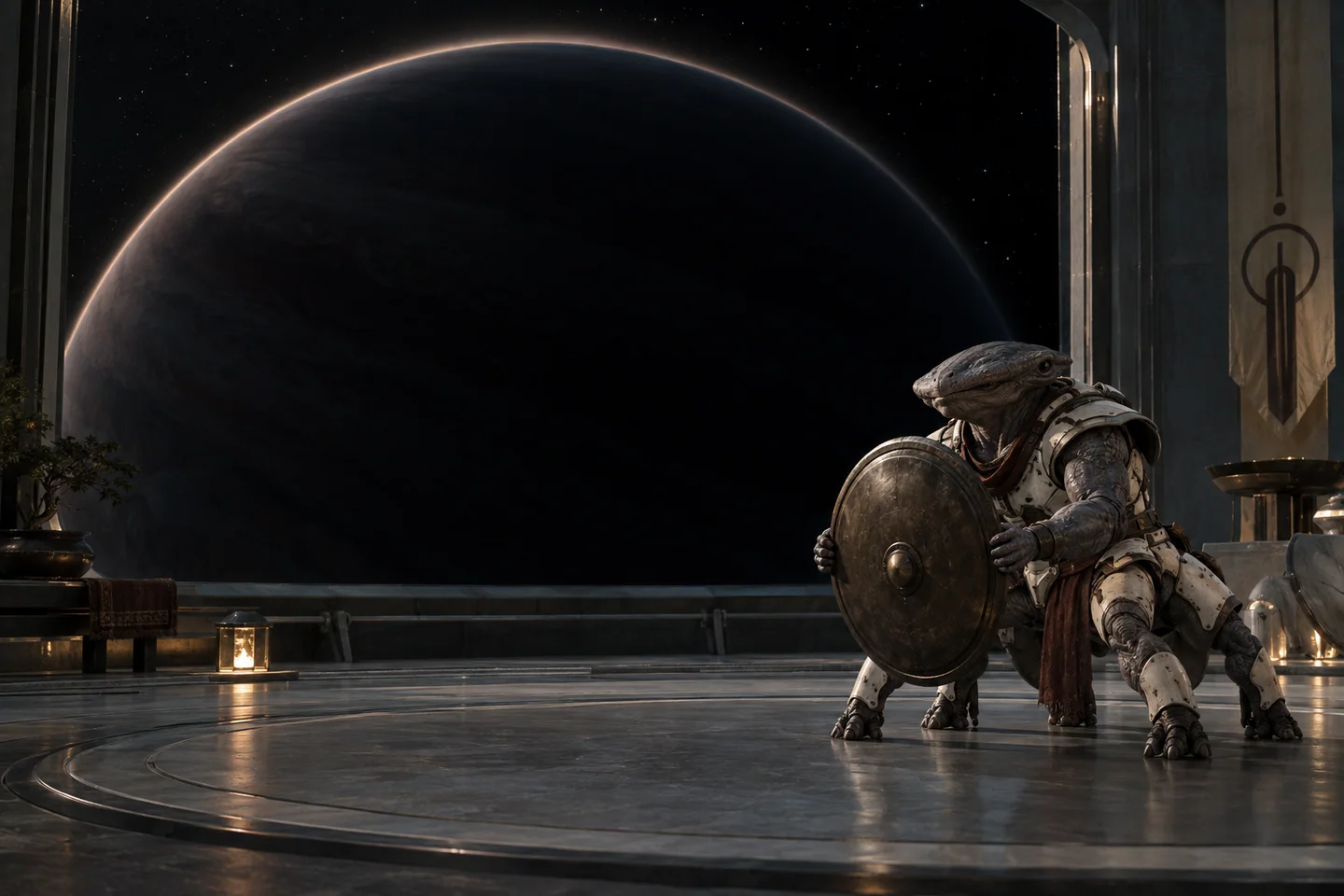
A low-bodied warrior practices with a bronze shield while an immense dark planet hides the star beyond an orbital sanctuary. Fictional warrior portrait: He raises the shield only far enough to feel its weight settle through his arms. Beyond the window, the star has disappeared behind the great planetary disk. The room remains familiar, yet the change in light makes every sound seem closer. He notices the impulse to brace against a danger that has not arrived and lets the next movement begin more slowly. His practice is to remain useful when certainty diminishes. He turns the shield, checks his footing and leaves enough space to see around its edge. Protection can become an obstacle if it blocks the information needed to decide. The exercise asks him to hold a boundary while keeping his attention open, a task that becomes harder when his imagination supplies what his eyes cannot see. Earlier in his training, darkness felt like an invitation to invent enemies. He remembers the effort spent answering possibilities as though they were facts. Experience has taught him to name what is present: the floor beneath him, the pressure of the grip, the quiet operation of the shelter. The unknown remains, but it no longer needs to fill every part of the room. The immense shadow offers a scale for that uncertainty. A world can hide a star from one observer without extinguishing its light. He takes this as a private metaphor, knowing that the universe has not arranged the passage for his instruction. His view is partial. A change in perspective may reveal something his strongest conviction has overlooked. When the exercise ends, he lowers the shield before fatigue makes the movement careless. Courage has taken a modest form: staying attentive without demanding reassurance, protecting without closing himself away, and allowing the next interval to arrive before deciding what it means. He will need the same discipline when the challenge before him has a voice and a face.
The imagined scene
The host system is real. All alien organisms, robots, societies and social histories are fictional. Moons, rings, terrain and weather are artistic assumptions unless specifically supported by a cited source. These images are not calibrated simulations of the sky.
The scientific anchor
HD 80606 b is a catalogued exoplanet orbiting HD 80606. The saved NASA composite snapshot lists an orbital period of 111.436765 days; uncertainties, limits and source provenance are preserved in the companion measurement table. Viewpoint: enclosed orbital sanctuary. All warriors, beliefs, cultures and constructed environments are fictional.
Pearson et al. 2022 · NASA Exoplanet Archive system overview · Naef et al. 2001 · Southworth 2011 · Wittenmyer et al. 2007
Available measurements
Host: HD 80606 · 2 catalog star(s) · Giant-size planet
NASA composite catalog values may combine different papers. Errors and upper/lower limits are retained. “Calculated Value” means derived or estimated. Msini is a minimum mass. Missing values are unknown. A multiple-star system’s single stellar row does not describe every component. Equilibrium temperature is not a measured surface temperature.
| Quantity | Value & uncertainty | Unit | Paper / source |
|---|---|---|---|
| Planet radius | 11.568 [+0.16813 / -0.16813] | Earth radii | Pearson et al. 2022 |
| Planet mass | 1,323.5 [+1.4938 / -1.4938] | Earth masses | Pearson et al. 2022 |
| Bulk density | 5.08 [+0.32 / -0.32] | g/cm³ | Southworth 2011 |
| Orbital period | 111.44 [+7.4e-05 / -7.4e-05] | days | Pearson et al. 2022 |
| Orbital semimajor axis | 0.4603 [+0.0021 / -0.0021] | AU | Pearson et al. 2022 |
| Orbital eccentricity | 0.93183 [+0.00014 / -0.00014] | Pearson et al. 2022 | |
| Orbital inclination | 89.24 [+0.01 / -0.01] | degrees | Pearson et al. 2022 |
| Irradiation | 4.6941 [+0.1147 / -0.1147] | Earth flux | Calculated Value |
| Equilibrium temperature | 405 [+7 / -7] | K; not surface temperature | Southworth 2011 |
| Catalog stellar effective temperature | 5,565 | K | Pearson et al. 2022 |
| Catalog stellar radius | 1.05 [+0.01 / -0.01] | Solar radii | Pearson et al. 2022 |
| Catalog stellar mass | 1.05 | Solar masses | Pearson et al. 2022 |
| Catalog stellar luminosity | -0.00237 [+0.00874 / -0.01095] | log10 Solar luminosity | Wittenmyer et al. 2007 |
| Catalog stellar age | 5.9 [+1.6 / -2] | Gyr | Bonomo et al. 2017 |
| Catalog stellar metallicity | 0.35 | dex | Pearson et al. 2022 |
| System distance | 66.471 [+0.1612 / -0.1604] | pc | TICv8 |
What about life?
Likely a deep gaseous envelope, without a solid exterior surface. Atmospheric or moon life is speculative; this is not proof that all life is impossible. No confirmed life; no planet-specific biosignature literature review in this release.
Papers and references
Pearson et al. 2022 · NASA Exoplanet Archive system overview · Naef et al. 2001 · Southworth 2011 · Wittenmyer et al. 2007 · Bonomo et al. 2017 · TICv8