The uncounted stars
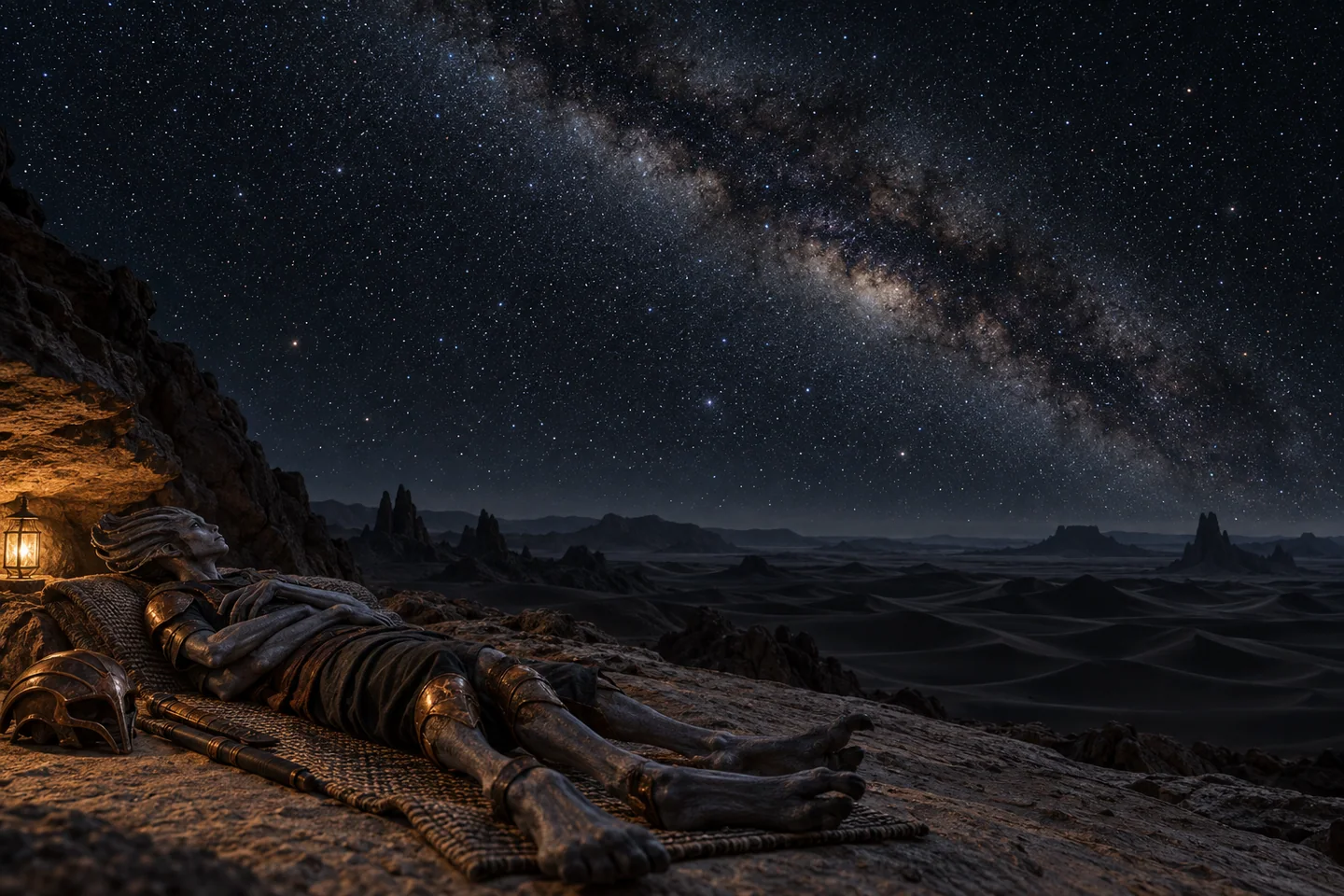
A warrior rests on a woven mat beneath a wide star field, with equipment set aside after training. Fictional warrior portrait: He lies back before the last tension of practice has left his hands. At first he follows familiar patterns through the stars, grouping points into shapes that resemble the routes and gestures of his training. Then the pattern slips away. More lights appear wherever he looks, and he permits his attention to wander without turning every new impression into a task. Rest was once difficult for him to defend. He could list movements completed and distances traveled, but stillness offered little evidence he could display. He learned to remain busy even when effort stopped being useful. Tonight the equipment rests beside the mat, within reach but outside his hands, and he lets the absence of a demand become part of the practice. The warmth at his side comes from a small sheltered lamp. Its light reveals the weave beneath him and the worn edge of a guard; the immense sky remains beyond its reach. The contrast makes the shelter feel intimate. Recovery depends on such limited, practical provisions: a safe place, a little warmth, and time that has not already been promised elsewhere. Looking upward, he thinks about the difference between receiving light and knowing its source. Distance can make distinct lives and histories appear as neighboring points. He cannot read those histories from the scene before him. Wonder begins where that limitation is admitted, leaving room for questions that do not have to be answered before he can close his eyes. Tomorrow he will return to deliberate movement. Tonight he allows the day to end without adding one more test. His connection to the cosmos includes this permission to be a resting creature within it. Strength can be renewed while nothing outwardly impressive happens, and a warrior who recognizes that may have more to offer when effort is needed again.
The imagined scene
The host system is real. All alien organisms, robots, societies and social histories are fictional. Moons, rings, terrain and weather are artistic assumptions unless specifically supported by a cited source. These images are not calibrated simulations of the sky.
The scientific anchor
Kepler-186 f is a catalogued exoplanet orbiting Kepler-186. The saved NASA composite snapshot lists an orbital period of 129.9441 days; uncertainties, limits and source provenance are preserved in the companion measurement table. Viewpoint: speculative nocturnal ridge. All warriors, beliefs, cultures and constructed environments are fictional.
Torres et al. 2015 · NASA Exoplanet Archive system overview · Quintana et al. 2014 · Q1-Q17 DR25 KOI Table · TICv8
The NASA archive flags this planet as controversial. Its inclusion here follows the catalog and is not independent confirmation.
Available measurements
Host: Kepler-186 · 1 catalog star(s) · Rocky-size candidate
NASA composite catalog values may combine different papers. Errors and upper/lower limits are retained. “Calculated Value” means derived or estimated. Msini is a minimum mass. Missing values are unknown. A multiple-star system’s single stellar row does not describe every component. Equilibrium temperature is not a measured surface temperature.
| Quantity | Value & uncertainty | Unit | Paper / source |
|---|---|---|---|
| Planet radius | 1.17 [+0.08 / -0.08] | Earth radii | Torres et al. 2015 |
| Planet mass | 1.71 | Earth masses | Calculated Value |
| Bulk density | 5.87 | g/cm³ | Calculated Value |
| Orbital period | 129.94 [+0.0013 / -0.0012] | days | Torres et al. 2015 |
| Orbital semimajor axis | 0.432 [+0.171 / -0.053] | AU | Torres et al. 2015 |
| Orbital eccentricity | ≥ 0.04 (lower limit) [+0.07 / -0.04] | Torres et al. 2015 | |
| Orbital inclination | 89.96 [+0.04 / -0.1] | degrees | Torres et al. 2015 |
| Irradiation | 0.3 [+0.1 / -0.15] | Earth flux | Torres et al. 2015 |
| Equilibrium temperature | 177 | K; not surface temperature | Q1-Q17 DR25 KOI Table |
| Catalog stellar effective temperature | 3,755 [+90 / -90] | K | Torres et al. 2015 |
| Catalog stellar radius | 0.523 [+0.023 / -0.021] | Solar radii | Torres et al. 2015 |
| Catalog stellar mass | 0.544 [+0.024 / -0.021] | Solar masses | Torres et al. 2015 |
| Catalog stellar luminosity | -1.26 [+0.079 / -0.05] | log10 Solar luminosity | Torres et al. 2015 |
| Catalog stellar age | 4 [+0.6 / -0.6] | Gyr | Torres et al. 2015 |
| Catalog stellar metallicity | -0.26 [+0.12 / -0.12] | dex | Torres et al. 2015 |
| System distance | 177.59 [+0.774 / -0.774] | pc | TICv8 |
What about life?
Passes a deliberately broad 0.25–1.75 Earth-flux triage window. This is not a calculated habitable zone or evidence of water or life. Atmosphere, surface pressure, water inventory, stellar activity and orbital history remain unassessed. Archive controversy flag is set; review planet status before production. No confirmed life; no planet-specific biosignature literature review in this release.
Papers and references
Torres et al. 2015 · NASA Exoplanet Archive system overview · Quintana et al. 2014 · Q1-Q17 DR25 KOI Table · TICv8