The care of the blade
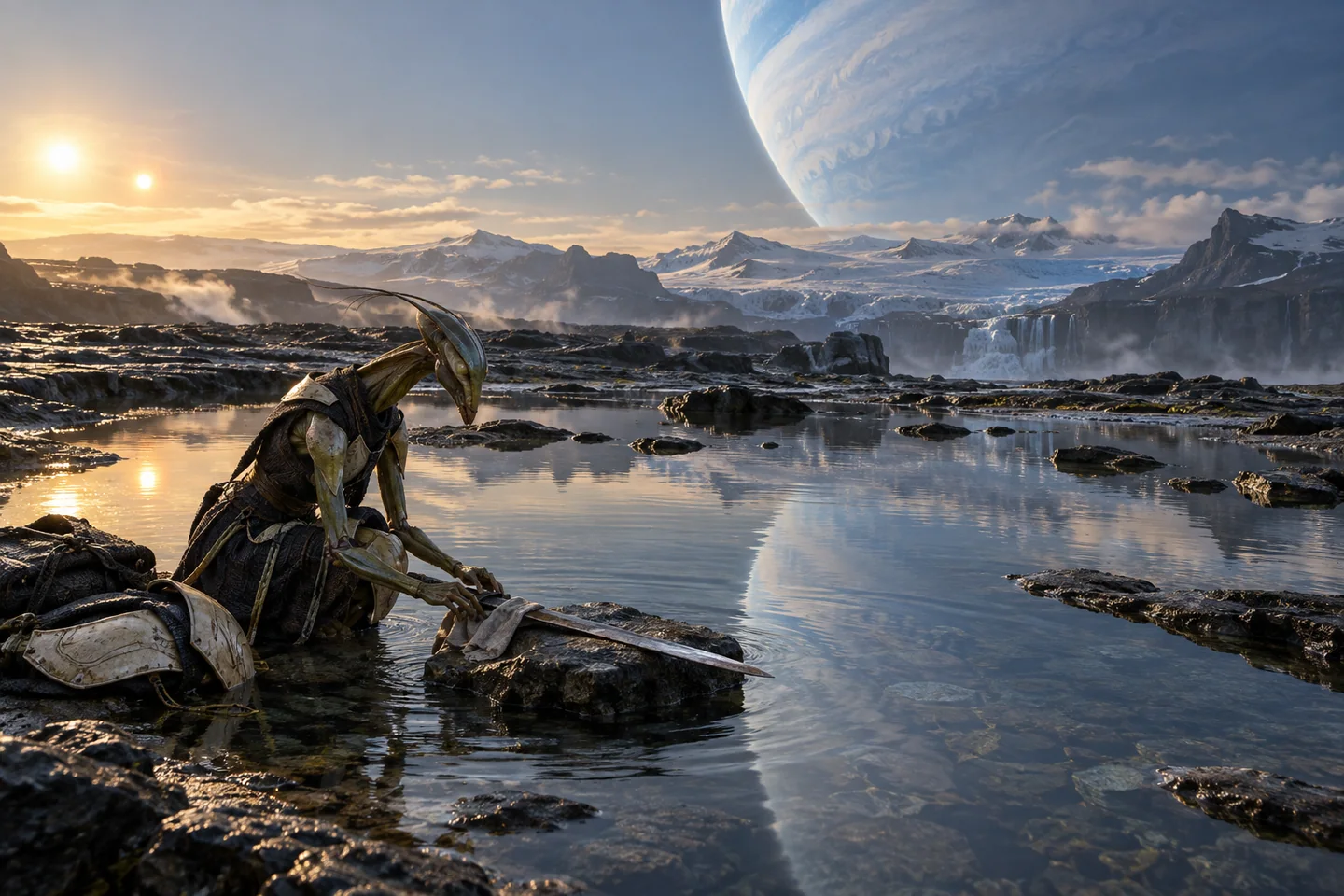
A mantis-like warrior tends a training blade beside a shallow pool beneath an imagined parent-planet sky and two suns. Fictional warrior portrait: She draws the cloth along the training blade and feels a roughness near its edge. The mark is small enough to miss in the middle of a form. Here, with the tool supported on stone and the movement unhurried, it becomes clear. She turns the blade toward the light and studies what can be cleaned, what needs repair, and what should be left for a more skilled hand. Maintenance brings a different kind of honesty from performance. A movement can look accomplished while hiding a weakness in its equipment. The work beside the pool removes that uncertainty one detail at a time. She checks the grip, dries the joins and keeps the cloth away from the places where careless pressure would be dangerous. Attention remains necessary after the formal exercise is over. The tool carries traces of more than her own practice. Someone selected its material, shaped its balance and fitted the surface to hands like hers. Its usefulness is a continuing collaboration. Tending it becomes a way to acknowledge those absent makers and the companions who may rely on the same equipment after she has finished with it. The great parent world reflected in the pool breaks apart when her hand disturbs the water. She watches the image gather again. The scene invites a thought about care without pretending that the sky has delivered a rule: what appears whole from a distance may depend on many small conditions nearby. She can take responsibility for some of those conditions, even while the greater world remains beyond her control. Before leaving, she dries the blade and gathers the pieces she brought. Nothing is abandoned for the next visitor to discover. Stewardship gives her strength a longer horizon. The value of practice will continue in the condition of the tools, the safety of their next use, and the habits of care another warrior may learn by watching.
The imagined scene
The host system is real. All alien organisms, robots, societies and social histories are fictional. Moons, rings, terrain and weather are artistic assumptions unless specifically supported by a cited source. These images are not calibrated simulations of the sky.
The scientific anchor
Kepler-413 b is a catalogued exoplanet orbiting Kepler-413. The saved NASA composite snapshot lists an orbital period of 66.262 days; uncertainties, limits and source provenance are preserved in the companion measurement table. Its catalog orbit is circumbinary. Viewpoint: imagined atmospheric moon. All warriors, beliefs, cultures and constructed environments are fictional. The depicted ground belongs to an invented moon; no exomoon detection or exposed solid surface on the parent giant is claimed.
Kostov et al. 2014 · NASA Exoplanet Archive system overview · Gaia DR2 · TICv8
Available measurements
Host: Kepler-413 · 2 catalog star(s) · Sub-Neptune / Neptune-size
NASA composite catalog values may combine different papers. Errors and upper/lower limits are retained. “Calculated Value” means derived or estimated. Msini is a minimum mass. Missing values are unknown. A multiple-star system’s single stellar row does not describe every component. Equilibrium temperature is not a measured surface temperature.
| Quantity | Value & uncertainty | Unit | Paper / source |
|---|---|---|---|
| Planet radius | 4.347 [+0.099 / -0.099] | Earth radii | Kostov et al. 2014 |
| Planet mass | 67 [+22 / -21] | Earth masses | Kostov et al. 2014 |
| Bulk density | 3.2 [+1 / -1] | g/cm³ | Kostov et al. 2014 |
| Orbital period | 66.262 [+0.024 / -0.021] | days | Kostov et al. 2014 |
| Orbital semimajor axis | 0.3553 [+0.002 / -0.0018] | AU | Kostov et al. 2014 |
| Orbital eccentricity | 0.1181 [+0.0018 / -0.0017] | Kostov et al. 2014 | |
| Orbital inclination | 89.929 [+0.024 / -0.016] | degrees | Kostov et al. 2014 |
| Irradiation | 2.9436 [+0.1909 / -0.1909] | Earth flux | Calculated Value |
| Equilibrium temperature | 334.96 | K; not surface temperature | Calculated Value |
| Catalog stellar effective temperature | 4,700 | K | Kostov et al. 2014 |
| Catalog stellar radius | 0.7761 [+0.0088 / -0.0096] | Solar radii | Kostov et al. 2014 |
| Catalog stellar mass | 0.82 [+0.015 / -0.014] | Solar masses | Kostov et al. 2014 |
| Catalog stellar luminosity | -0.42994 [+0.02689 / -0.02867] | log10 Solar luminosity | Gaia DR2 |
| Catalog stellar age | Unknown | Gyr | Source not supplied |
| Catalog stellar metallicity | -0.2 | dex | Kostov et al. 2014 |
| System distance | 847.54 [+22.587 / -21.464] | pc | TICv8 |
What about life?
A substantial volatile envelope is plausible. A habitable ocean or surface cannot be inferred from radius; atmosphere and interior research required. No confirmed life; no planet-specific biosignature literature review in this release.
Papers and references
Kostov et al. 2014 · NASA Exoplanet Archive system overview · Gaia DR2 · TICv8