The grazing rain
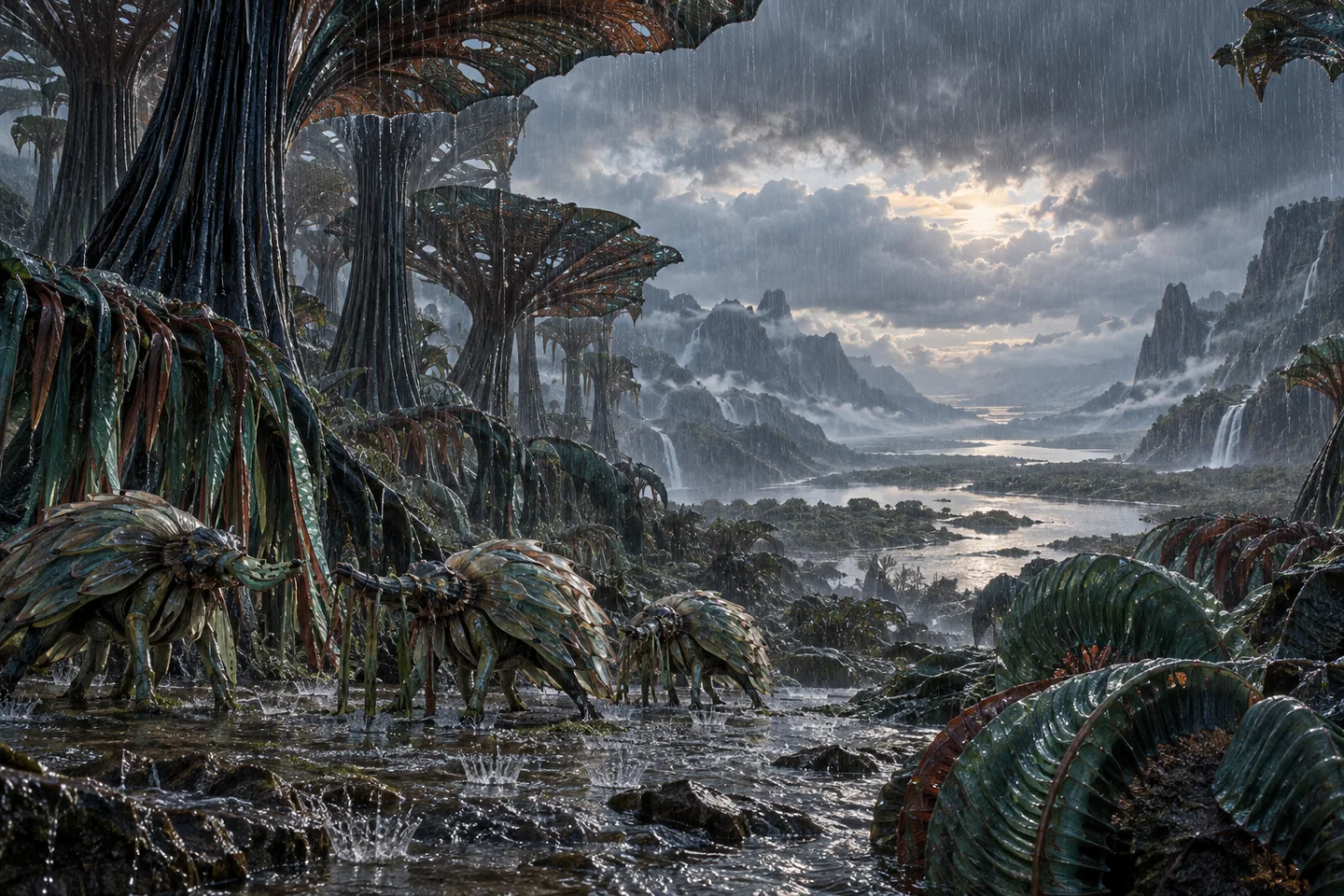
The host supplies energy, but the energy reaching a consumer has already passed through other organisms. Our catalog cannot measure productivity, food availability or the fraction lost between ecological stages. Even the listed planetary mass of 1.2 Earth masses is an estimate from a mass–radius relationship, not a dynamical weighing of this world [2]. Under heavy rain, low plate grazers crop loose tissue from the ribbon colonies. Their translucent overlapping plates and radial movement distinguish them from familiar terrestrial herbivores. Wet membranes trail close to the ground, making feeding possible without giving the animals an Earth-like head or jaw. The picture also shows a cost to the botanical life: tissue has been removed. The imagined colonies survive partial grazing by retaining protected growing regions and stored reserves. Nutrients return through waste and decomposition, while open patches create opportunities for younger growth. These are authored ecological rules, not measured traits. Rain and mist place the interaction inside a larger climate. The sky is silver because the assumed clouds scatter the light; the star need not appear as a disk for astronomy to drive the scene. Neither the color of the vegetation nor the presence of a grazer is evidence that this real planet is inhabited. Viewpoint: Flooded forest edge.
The imagined scene
The host system is real. All alien organisms, robots, societies and social histories are fictional. Moons, rings, terrain and weather are artistic assumptions unless specifically supported by a cited source. These images are not calibrated simulations of the sky.
The scientific anchor
Kepler-1649 c is a transiting planet around Kepler-1649. Its saved radius is 1.06 (+0.15 / −0.10) Earth radii and its orbital period is 19.53527 ± 0.00010 days [Vanderburg et al. 2020]. This scene explores stellar energy passed through a wet food web. Plate grazers trim photosynthetic tissue; regrowth and waste return nutrients to the wet ground. All weather, vegetation and other life are fictional.
Vanderburg et al. 2020 — Kepler-1649 c discovery and measured parameters · NASA Exoplanet Archive — Kepler-1649 c · Kiang et al. 2007 — photosynthetic spectra as a general research context · Vanderburg et al. 2020 · Q1-Q17 DR25 KOI Table
Available measurements
Host: Kepler-1649 · 1 catalog star(s) · Rocky-size candidate
NASA composite catalog values may combine different papers. Errors and upper/lower limits are retained. “Calculated Value” means derived or estimated. Msini is a minimum mass. Missing values are unknown. A multiple-star system’s single stellar row does not describe every component. Equilibrium temperature is not a measured surface temperature.
| Quantity | Value & uncertainty | Unit | Paper / source |
|---|---|---|---|
| Planet radius | 1.06 [+0.15 / -0.1] | Earth radii | Vanderburg et al. 2020 |
| Planet mass | 1.2 | Earth masses | Calculated Value |
| Bulk density | 5.54 | g/cm³ | Calculated Value |
| Orbital period | 19.535 [+0.0001 / -0.0001] | days | Vanderburg et al. 2020 |
| Orbital semimajor axis | 0.0649 | AU | Q1-Q17 DR25 KOI Table |
| Orbital eccentricity | 0 | Q1-Q17 DR25 KOI Table | |
| Orbital inclination | 89.339 [+0.056 / -0.056] | degrees | Vanderburg et al. 2020 |
| Irradiation | 0.75 [+0.032 / -0.302] | Earth flux | Vanderburg et al. 2020 |
| Equilibrium temperature | 234 [+20 / -20] | K; not surface temperature | Vanderburg et al. 2020 |
| Catalog stellar effective temperature | 3,240 [+61 / -61] | K | Vanderburg et al. 2020 |
| Catalog stellar radius | 0.2317 [+0.0049 / -0.0049] | Solar radii | Vanderburg et al. 2020 |
| Catalog stellar mass | 0.1977 [+0.0051 / -0.0051] | Solar masses | Vanderburg et al. 2020 |
| Catalog stellar luminosity | -2.2873 [+0.01652 / -0.01717] | log10 Solar luminosity | Vanderburg et al. 2020 |
| Catalog stellar age | Unknown | Gyr | Source not supplied |
| Catalog stellar metallicity | -0.15 [+0.11 / -0.11] | dex | Vanderburg et al. 2020 |
| System distance | 92.191 [+0.5489 / -0.5425] | pc | TICv8 |
What about life?
Passes a deliberately broad 0.25–1.75 Earth-flux triage window. This is not a calculated habitable zone or evidence of water or life. Atmosphere, surface pressure, water inventory, stellar activity and orbital history remain unassessed. No confirmed life; no planet-specific biosignature literature review in this release.
Papers and references
Vanderburg et al. 2020 — Kepler-1649 c discovery and measured parameters · NASA Exoplanet Archive — Kepler-1649 c · Kiang et al. 2007 — photosynthetic spectra as a general research context · Vanderburg et al. 2020 · Q1-Q17 DR25 KOI Table · TICv8