The wind archive
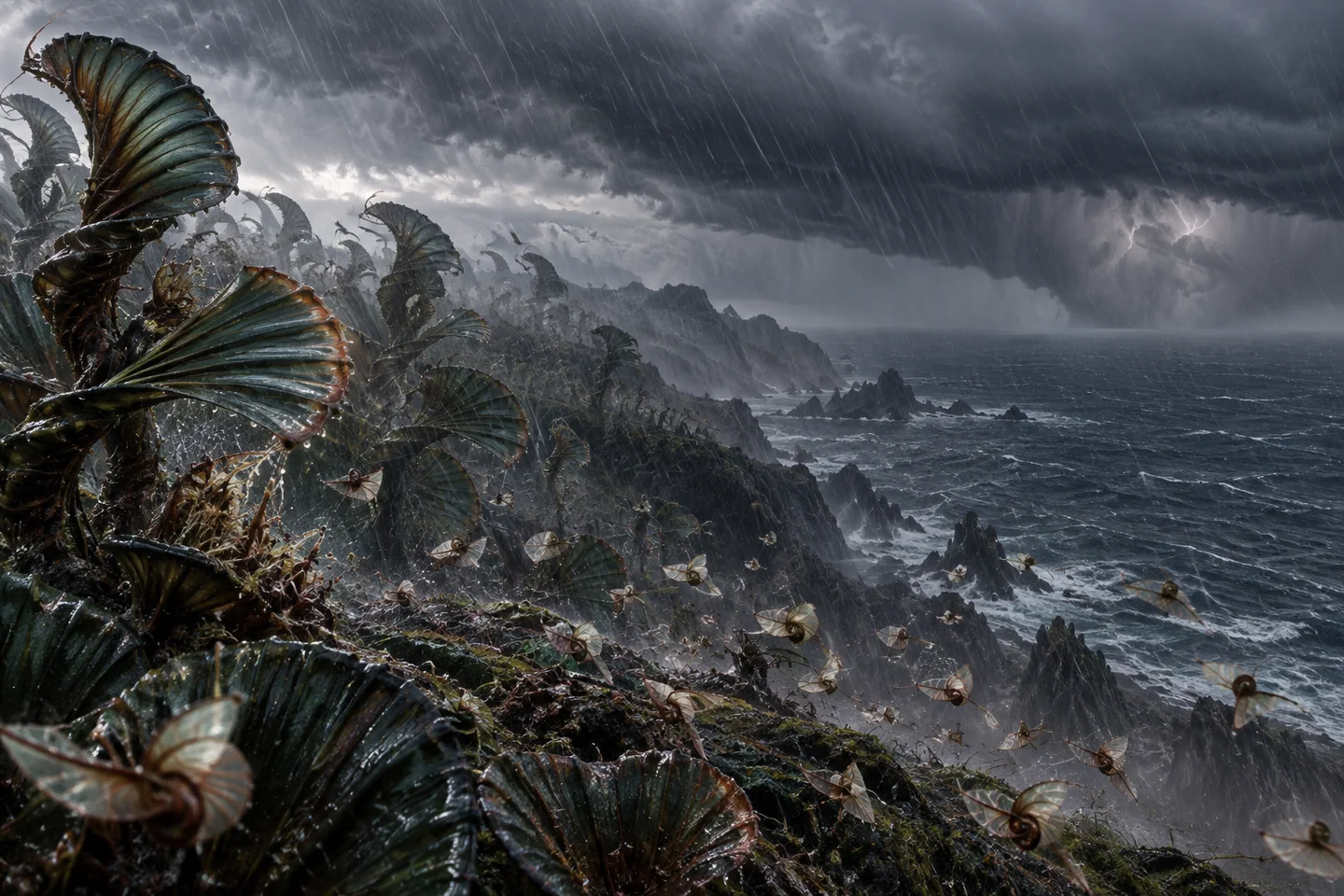
This book’s assumed synchronous rotation permits a persistent contrast between illuminated and dark regions. It does not require one particular wind pattern. Circulation would depend on atmospheric mass, heating, rotation and surface conditions, none constrained here well enough to predict this downpour [1, 2]. At the windward forest edge, living columns flex and the crowns partly fold. Rain crosses the view diagonally. Open reproductive chambers release helical propagules, some of which may settle in sheltered cracks beyond the parent colony. Their shape makes transport visible, without claiming a tested aerodynamic design. The forest’s mobile partners must negotiate the same weather. Small filter feeders intercept some material; others shelter behind ribs and beneath membranes. Most propagules fail to reach a useful site. The apparent abundance therefore represents investment and loss as much as successful reproduction. The image emphasizes a connection rather than a forecast: atmospheric motion could shape biological architecture and dispersal. No speed, pressure or rainfall rate should be read from the artwork. The electric glow within the distant cloud belongs to the fictional storm, and no season or recurring weather cycle is asserted. Viewpoint: Windward forest ridge.
The imagined scene
The host system is real. All alien organisms, robots, societies and social histories are fictional. Moons, rings, terrain and weather are artistic assumptions unless specifically supported by a cited source. These images are not calibrated simulations of the sky.
The scientific anchor
Kepler-1649 c is a transiting planet around Kepler-1649. Its saved radius is 1.06 (+0.15 / −0.10) Earth radii and its orbital period is 19.53527 ± 0.00010 days [Vanderburg et al. 2020]. This scene explores atmospheric circulation and propagule dispersal. Helical propagules disperse on atmospheric currents; flexible colonies reduce wind loading by folding. All weather, vegetation and other life are fictional.
Vanderburg et al. 2020 — Kepler-1649 c discovery and measured parameters · NASA Exoplanet Archive — Kepler-1649 c · Kiang et al. 2007 — photosynthetic spectra as a general research context · Vanderburg et al. 2020 · Q1-Q17 DR25 KOI Table
Available measurements
Host: Kepler-1649 · 1 catalog star(s) · Rocky-size candidate
NASA composite catalog values may combine different papers. Errors and upper/lower limits are retained. “Calculated Value” means derived or estimated. Msini is a minimum mass. Missing values are unknown. A multiple-star system’s single stellar row does not describe every component. Equilibrium temperature is not a measured surface temperature.
| Quantity | Value & uncertainty | Unit | Paper / source |
|---|---|---|---|
| Planet radius | 1.06 [+0.15 / -0.1] | Earth radii | Vanderburg et al. 2020 |
| Planet mass | 1.2 | Earth masses | Calculated Value |
| Bulk density | 5.54 | g/cm³ | Calculated Value |
| Orbital period | 19.535 [+0.0001 / -0.0001] | days | Vanderburg et al. 2020 |
| Orbital semimajor axis | 0.0649 | AU | Q1-Q17 DR25 KOI Table |
| Orbital eccentricity | 0 | Q1-Q17 DR25 KOI Table | |
| Orbital inclination | 89.339 [+0.056 / -0.056] | degrees | Vanderburg et al. 2020 |
| Irradiation | 0.75 [+0.032 / -0.302] | Earth flux | Vanderburg et al. 2020 |
| Equilibrium temperature | 234 [+20 / -20] | K; not surface temperature | Vanderburg et al. 2020 |
| Catalog stellar effective temperature | 3,240 [+61 / -61] | K | Vanderburg et al. 2020 |
| Catalog stellar radius | 0.2317 [+0.0049 / -0.0049] | Solar radii | Vanderburg et al. 2020 |
| Catalog stellar mass | 0.1977 [+0.0051 / -0.0051] | Solar masses | Vanderburg et al. 2020 |
| Catalog stellar luminosity | -2.2873 [+0.01652 / -0.01717] | log10 Solar luminosity | Vanderburg et al. 2020 |
| Catalog stellar age | Unknown | Gyr | Source not supplied |
| Catalog stellar metallicity | -0.15 [+0.11 / -0.11] | dex | Vanderburg et al. 2020 |
| System distance | 92.191 [+0.5489 / -0.5425] | pc | TICv8 |
What about life?
Passes a deliberately broad 0.25–1.75 Earth-flux triage window. This is not a calculated habitable zone or evidence of water or life. Atmosphere, surface pressure, water inventory, stellar activity and orbital history remain unassessed. No confirmed life; no planet-specific biosignature literature review in this release.
Papers and references
Vanderburg et al. 2020 — Kepler-1649 c discovery and measured parameters · NASA Exoplanet Archive — Kepler-1649 c · Kiang et al. 2007 — photosynthetic spectra as a general research context · Vanderburg et al. 2020 · Q1-Q17 DR25 KOI Table · TICv8