The borrowed night
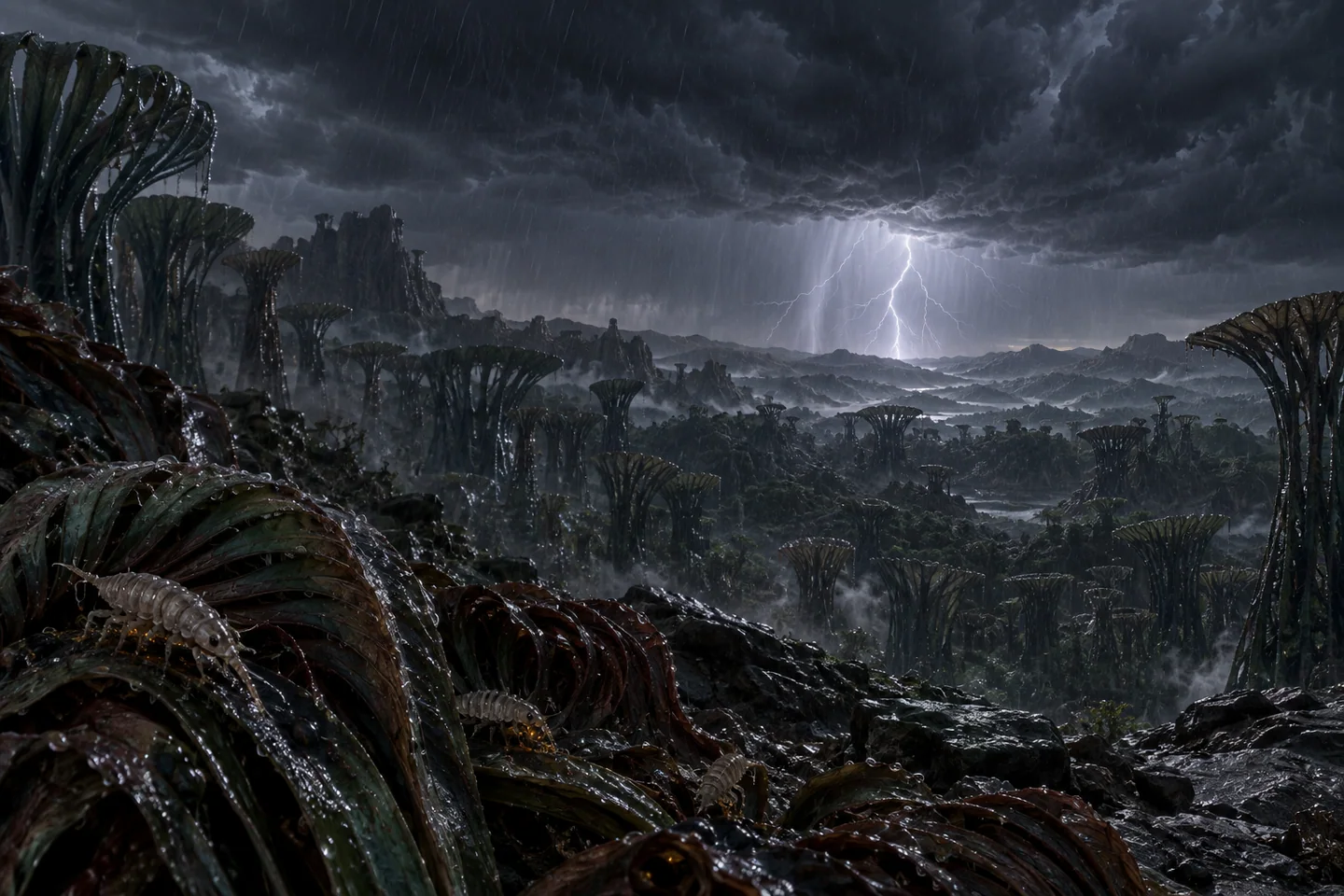
The star is below the local horizon in this imagined dark-side forest, but its influence continues through transported heat and stored chemical energy. A synchronous planet need not have a frozen, airless night hemisphere; neither does a short orbit guarantee a warm one. Atmospheric survival and heat transport require evidence this image cannot supply [2]. A distant lightning strike briefly reveals rain and folded forest silhouettes. In the foreground, decomposers work on fallen canopy tissue that was produced under illumination elsewhere or at an earlier stage of this fictional landscape. Their food stores energy originally captured by other organisms. Tiny amber points mark invented biochemical signaling. They consume energy; they do not create a replacement sun or support the entire ecosystem through their glow. Most of the scene remains dark so that the luminous detail does not become a misleading promise of limitless biological power. The night forest is therefore dependent. Its material arrives through transport, growth and decay within the scenario. The real observations establish a planet orbiting a red dwarf, while this plate asks how an unseen part of a possible biosphere might depend on resources made beyond its own horizon. Viewpoint: Dark forest beyond the assumed terminator.
The imagined scene
The host system is real. All alien organisms, robots, societies and social histories are fictional. Moons, rings, terrain and weather are artistic assumptions unless specifically supported by a cited source. These images are not calibrated simulations of the sky.
The scientific anchor
Kepler-1649 c is a transiting planet around Kepler-1649. Its saved radius is 1.06 (+0.15 / −0.10) Earth radii and its orbital period is 19.53527 ± 0.00010 days [Vanderburg et al. 2020]. This scene explores energy storage beyond direct illumination. Decomposers use stored chemical energy in fallen tissue; invented faint signaling does not power photosynthesis. All weather, vegetation and other life are fictional.
Vanderburg et al. 2020 — Kepler-1649 c discovery and measured parameters · NASA Exoplanet Archive — Kepler-1649 c · Kiang et al. 2007 — photosynthetic spectra as a general research context · Vanderburg et al. 2020 · Q1-Q17 DR25 KOI Table
Available measurements
Host: Kepler-1649 · 1 catalog star(s) · Rocky-size candidate
NASA composite catalog values may combine different papers. Errors and upper/lower limits are retained. “Calculated Value” means derived or estimated. Msini is a minimum mass. Missing values are unknown. A multiple-star system’s single stellar row does not describe every component. Equilibrium temperature is not a measured surface temperature.
| Quantity | Value & uncertainty | Unit | Paper / source |
|---|---|---|---|
| Planet radius | 1.06 [+0.15 / -0.1] | Earth radii | Vanderburg et al. 2020 |
| Planet mass | 1.2 | Earth masses | Calculated Value |
| Bulk density | 5.54 | g/cm³ | Calculated Value |
| Orbital period | 19.535 [+0.0001 / -0.0001] | days | Vanderburg et al. 2020 |
| Orbital semimajor axis | 0.0649 | AU | Q1-Q17 DR25 KOI Table |
| Orbital eccentricity | 0 | Q1-Q17 DR25 KOI Table | |
| Orbital inclination | 89.339 [+0.056 / -0.056] | degrees | Vanderburg et al. 2020 |
| Irradiation | 0.75 [+0.032 / -0.302] | Earth flux | Vanderburg et al. 2020 |
| Equilibrium temperature | 234 [+20 / -20] | K; not surface temperature | Vanderburg et al. 2020 |
| Catalog stellar effective temperature | 3,240 [+61 / -61] | K | Vanderburg et al. 2020 |
| Catalog stellar radius | 0.2317 [+0.0049 / -0.0049] | Solar radii | Vanderburg et al. 2020 |
| Catalog stellar mass | 0.1977 [+0.0051 / -0.0051] | Solar masses | Vanderburg et al. 2020 |
| Catalog stellar luminosity | -2.2873 [+0.01652 / -0.01717] | log10 Solar luminosity | Vanderburg et al. 2020 |
| Catalog stellar age | Unknown | Gyr | Source not supplied |
| Catalog stellar metallicity | -0.15 [+0.11 / -0.11] | dex | Vanderburg et al. 2020 |
| System distance | 92.191 [+0.5489 / -0.5425] | pc | TICv8 |
What about life?
Passes a deliberately broad 0.25–1.75 Earth-flux triage window. This is not a calculated habitable zone or evidence of water or life. Atmosphere, surface pressure, water inventory, stellar activity and orbital history remain unassessed. No confirmed life; no planet-specific biosignature literature review in this release.
Papers and references
Vanderburg et al. 2020 — Kepler-1649 c discovery and measured parameters · NASA Exoplanet Archive — Kepler-1649 c · Kiang et al. 2007 — photosynthetic spectra as a general research context · Vanderburg et al. 2020 · Q1-Q17 DR25 KOI Table · TICv8