Where daylight thins
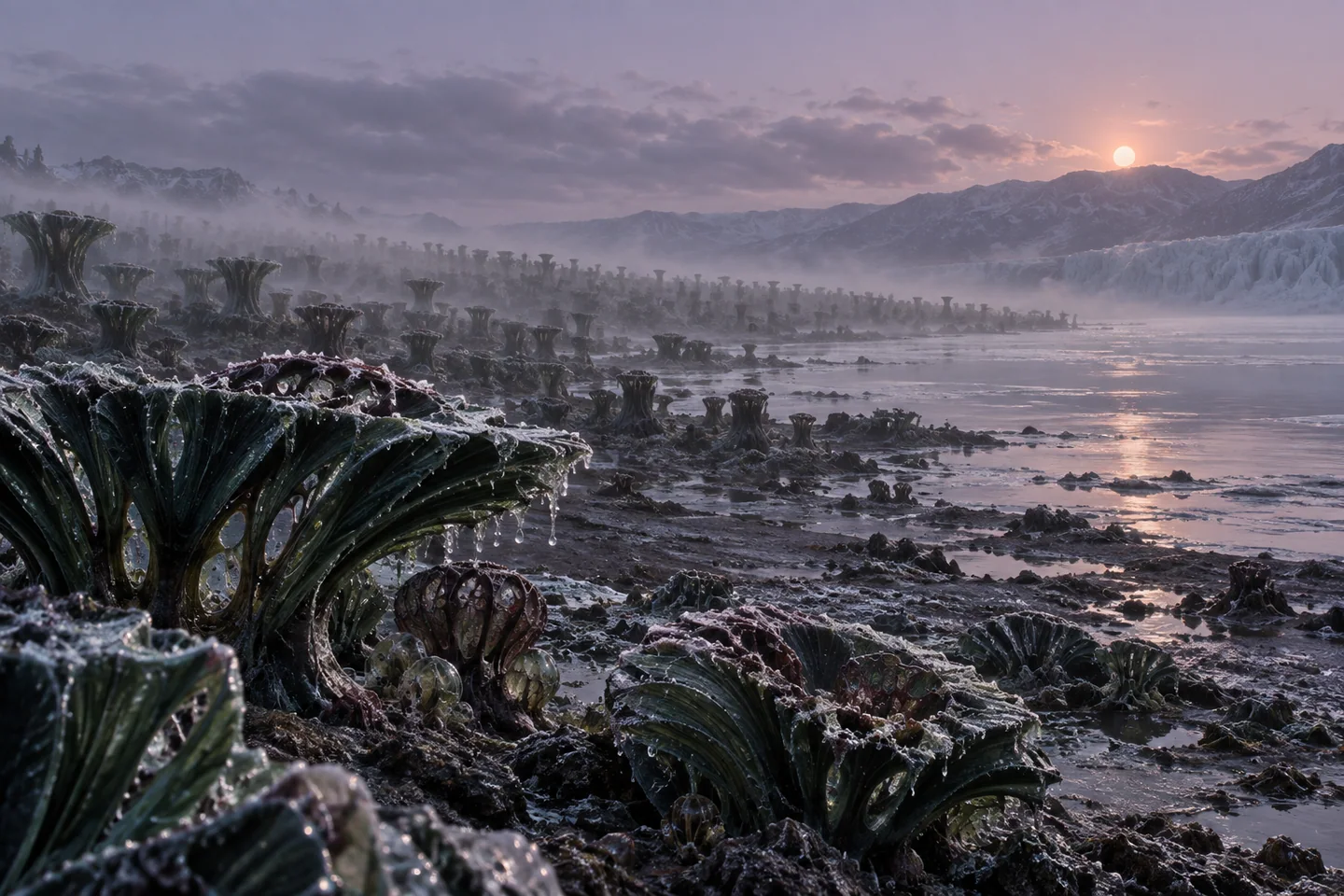
The saved equilibrium-temperature estimate is 234 ± 20 kelvin. Equilibrium temperature describes a model energy balance; it is not a measurement of the ground or the lake in this image. Atmospheric warming, albedo and heat redistribution could produce very different local conditions, or no liquid refuge at all [1, 2]. We place this scene near the boundary of illumination in our assumed rotation state. Tall forest gradually gives way to low folded growth, mist and frost. The host sits close to a ridge because of the chosen viewpoint. It is not necessarily setting; the scene is a location within a scenario, not a timestamp in a measured day. The low colonies shelter small partners beneath transparent insulating films. Water collects in protected depressions while exposed ridges freeze. The invented biology uses architecture to moderate its immediate surroundings, trading extensive light-gathering area for a smaller, more sheltered form. Nothing in the catalog establishes this forest boundary, ice line or habitat. A tested climate model would be needed even to argue that such a transition can persist. The plate makes the uncertainty visible by placing fragile living structures against an immense cold landscape, where the proposed water cycle approaches its limits. Viewpoint: Forest boundary near the assumed terminator.
The imagined scene
The host system is real. All alien organisms, robots, societies and social histories are fictional. Moons, rings, terrain and weather are artistic assumptions unless specifically supported by a cited source. These images are not calibrated simulations of the sky.
The scientific anchor
Kepler-1649 c is a transiting planet around Kepler-1649. Its saved radius is 1.06 (+0.15 / −0.10) Earth radii and its orbital period is 19.53527 ± 0.00010 days [Vanderburg et al. 2020]. This scene explores oblique illumination and a cold boundary. Low colonies and insulating films shelter partners in an invented liquid-water refuge. All weather, vegetation and other life are fictional.
Vanderburg et al. 2020 — Kepler-1649 c discovery and measured parameters · NASA Exoplanet Archive — Kepler-1649 c · Kiang et al. 2007 — photosynthetic spectra as a general research context · Vanderburg et al. 2020 · Q1-Q17 DR25 KOI Table
Available measurements
Host: Kepler-1649 · 1 catalog star(s) · Rocky-size candidate
NASA composite catalog values may combine different papers. Errors and upper/lower limits are retained. “Calculated Value” means derived or estimated. Msini is a minimum mass. Missing values are unknown. A multiple-star system’s single stellar row does not describe every component. Equilibrium temperature is not a measured surface temperature.
| Quantity | Value & uncertainty | Unit | Paper / source |
|---|---|---|---|
| Planet radius | 1.06 [+0.15 / -0.1] | Earth radii | Vanderburg et al. 2020 |
| Planet mass | 1.2 | Earth masses | Calculated Value |
| Bulk density | 5.54 | g/cm³ | Calculated Value |
| Orbital period | 19.535 [+0.0001 / -0.0001] | days | Vanderburg et al. 2020 |
| Orbital semimajor axis | 0.0649 | AU | Q1-Q17 DR25 KOI Table |
| Orbital eccentricity | 0 | Q1-Q17 DR25 KOI Table | |
| Orbital inclination | 89.339 [+0.056 / -0.056] | degrees | Vanderburg et al. 2020 |
| Irradiation | 0.75 [+0.032 / -0.302] | Earth flux | Vanderburg et al. 2020 |
| Equilibrium temperature | 234 [+20 / -20] | K; not surface temperature | Vanderburg et al. 2020 |
| Catalog stellar effective temperature | 3,240 [+61 / -61] | K | Vanderburg et al. 2020 |
| Catalog stellar radius | 0.2317 [+0.0049 / -0.0049] | Solar radii | Vanderburg et al. 2020 |
| Catalog stellar mass | 0.1977 [+0.0051 / -0.0051] | Solar masses | Vanderburg et al. 2020 |
| Catalog stellar luminosity | -2.2873 [+0.01652 / -0.01717] | log10 Solar luminosity | Vanderburg et al. 2020 |
| Catalog stellar age | Unknown | Gyr | Source not supplied |
| Catalog stellar metallicity | -0.15 [+0.11 / -0.11] | dex | Vanderburg et al. 2020 |
| System distance | 92.191 [+0.5489 / -0.5425] | pc | TICv8 |
What about life?
Passes a deliberately broad 0.25–1.75 Earth-flux triage window. This is not a calculated habitable zone or evidence of water or life. Atmosphere, surface pressure, water inventory, stellar activity and orbital history remain unassessed. No confirmed life; no planet-specific biosignature literature review in this release.
Papers and references
Vanderburg et al. 2020 — Kepler-1649 c discovery and measured parameters · NASA Exoplanet Archive — Kepler-1649 c · Kiang et al. 2007 — photosynthetic spectra as a general research context · Vanderburg et al. 2020 · Q1-Q17 DR25 KOI Table · TICv8