Lightning over the canopy
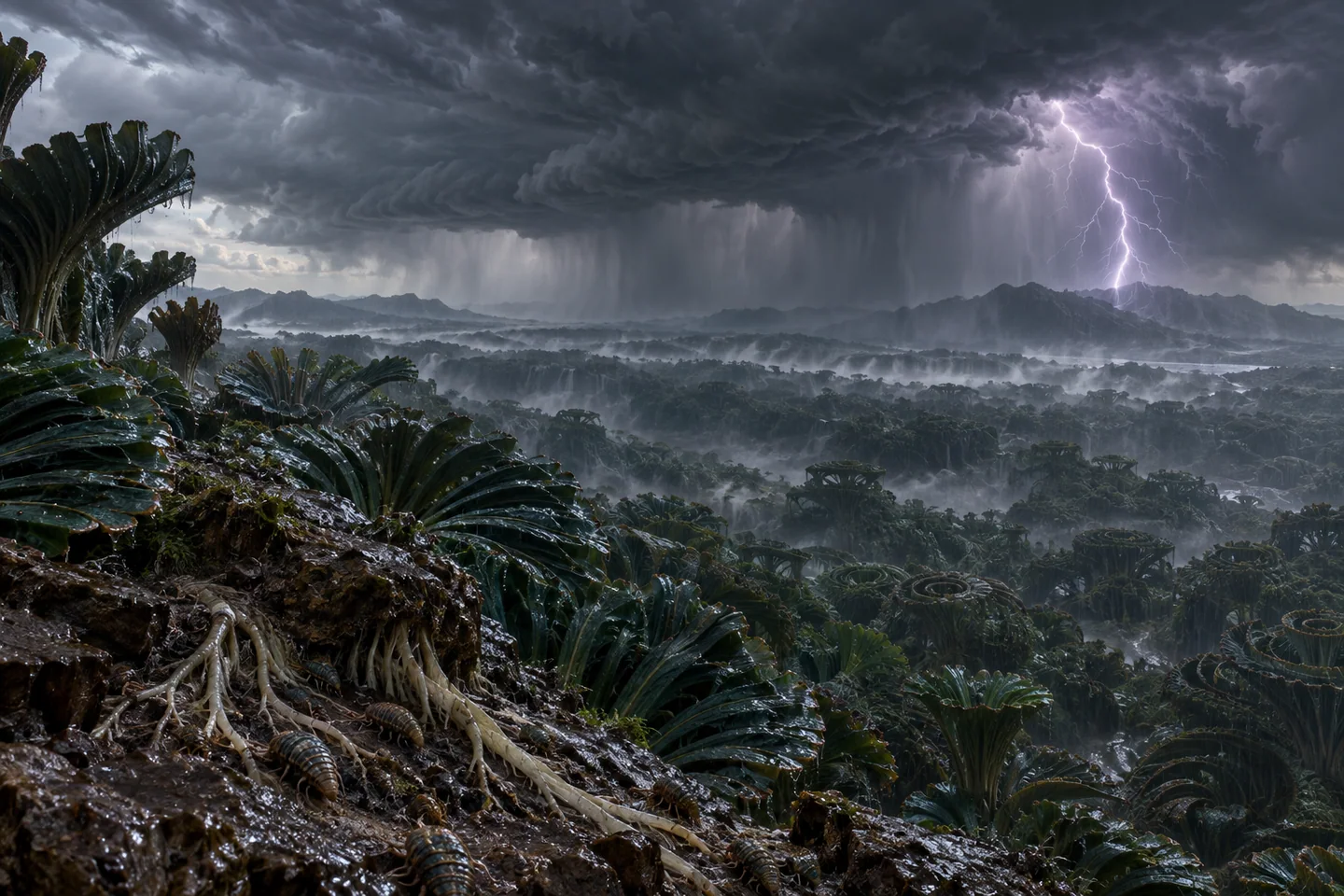
A lightning channel briefly illuminates the canopy, revealing an imagined atmosphere at work. Clouds can separate electrical charge, but this particular storm’s chemistry, pressure and charge structure are not known. The existence of Kepler-1649 c does not establish lightning on it; the scene borrows a physical possibility for an explicitly fictional weather system [2]. Below the flash, an eroded bank exposes pale exchange cords running from the surface fans into mineral grains. Small burrowers open pores, transport debris and disturb weathered rock. The rooted colonies provide organic material; the underground partners make some mineral resources easier to reach. No specific metabolism or elemental requirement is claimed. The towering crowns matter because the useful work remains distributed. A large light-collecting surface depends on a supply network hidden beneath it, and that network depends on liquid pathways through the substrate. In this scenario, rainfall connects the visible forest to its less visible biological partners. The lightning is placed at a distant ridge, where it gives scale to the storm. It is not presented as fertilizer, an energy source for the forest or a detected event. The star supplies the long-term energy premise; a brief electrical discharge reveals the landscape rather than explaining its existence. Viewpoint: Storm-facing ridge above a dense forest.
The imagined scene
The host system is real. All alien organisms, robots, societies and social histories are fictional. Moons, rings, terrain and weather are artistic assumptions unless specifically supported by a cited source. These images are not calibrated simulations of the sky.
The scientific anchor
Kepler-1649 c is a transiting planet around Kepler-1649. Its saved radius is 1.06 (+0.15 / −0.10) Earth radii and its orbital period is 19.53527 ± 0.00010 days [Vanderburg et al. 2020]. This scene explores atmospheric electricity as a fictional weather process. Root-like exchange cords and burrowers supply mineral nutrients beneath the rain-fed canopy. All weather, vegetation and other life are fictional.
Vanderburg et al. 2020 — Kepler-1649 c discovery and measured parameters · NASA Exoplanet Archive — Kepler-1649 c · Kiang et al. 2007 — photosynthetic spectra as a general research context · Vanderburg et al. 2020 · Q1-Q17 DR25 KOI Table
Available measurements
Host: Kepler-1649 · 1 catalog star(s) · Rocky-size candidate
NASA composite catalog values may combine different papers. Errors and upper/lower limits are retained. “Calculated Value” means derived or estimated. Msini is a minimum mass. Missing values are unknown. A multiple-star system’s single stellar row does not describe every component. Equilibrium temperature is not a measured surface temperature.
| Quantity | Value & uncertainty | Unit | Paper / source |
|---|---|---|---|
| Planet radius | 1.06 [+0.15 / -0.1] | Earth radii | Vanderburg et al. 2020 |
| Planet mass | 1.2 | Earth masses | Calculated Value |
| Bulk density | 5.54 | g/cm³ | Calculated Value |
| Orbital period | 19.535 [+0.0001 / -0.0001] | days | Vanderburg et al. 2020 |
| Orbital semimajor axis | 0.0649 | AU | Q1-Q17 DR25 KOI Table |
| Orbital eccentricity | 0 | Q1-Q17 DR25 KOI Table | |
| Orbital inclination | 89.339 [+0.056 / -0.056] | degrees | Vanderburg et al. 2020 |
| Irradiation | 0.75 [+0.032 / -0.302] | Earth flux | Vanderburg et al. 2020 |
| Equilibrium temperature | 234 [+20 / -20] | K; not surface temperature | Vanderburg et al. 2020 |
| Catalog stellar effective temperature | 3,240 [+61 / -61] | K | Vanderburg et al. 2020 |
| Catalog stellar radius | 0.2317 [+0.0049 / -0.0049] | Solar radii | Vanderburg et al. 2020 |
| Catalog stellar mass | 0.1977 [+0.0051 / -0.0051] | Solar masses | Vanderburg et al. 2020 |
| Catalog stellar luminosity | -2.2873 [+0.01652 / -0.01717] | log10 Solar luminosity | Vanderburg et al. 2020 |
| Catalog stellar age | Unknown | Gyr | Source not supplied |
| Catalog stellar metallicity | -0.15 [+0.11 / -0.11] | dex | Vanderburg et al. 2020 |
| System distance | 92.191 [+0.5489 / -0.5425] | pc | TICv8 |
What about life?
Passes a deliberately broad 0.25–1.75 Earth-flux triage window. This is not a calculated habitable zone or evidence of water or life. Atmosphere, surface pressure, water inventory, stellar activity and orbital history remain unassessed. No confirmed life; no planet-specific biosignature literature review in this release.
Papers and references
Vanderburg et al. 2020 — Kepler-1649 c discovery and measured parameters · NASA Exoplanet Archive — Kepler-1649 c · Kiang et al. 2007 — photosynthetic spectra as a general research context · Vanderburg et al. 2020 · Q1-Q17 DR25 KOI Table · TICv8